Marlin Camp Gun
| Length Overall | Barrel Length | Weight | Caliber | Action Type | Magazine Capacity |
| 35" | 16" | 6 Pounds 7oz. | .45 A.C.P. | Recoil Semi | 7+1 |
The stubby .45 auto cartridge is very efficient when loaded with fast burning powders. In the average 5" pistol barrel, the fast burning powder is almost completely burned when the bullet exits, meaning that in the longer barreled carbine, the bullet can actually be slowed down by barrel friction. The usual cure for this type of thing is to either increase the pressure or go with a slower burning powder, unfortunately an unlocked action does not lend itself to slow powders or higher pressures. This type of action is generally used for low powered pistol cartridges, and .22 rifles. It works in this particular rifle because Marlin has made the bolt rather heavy, depending on inertia rather than a locking action to retard the bolt's rearward motion. This is perfectly fine as long as standard loads are used. In the case of a higher pressure load, the bolt would be slammed back into the receiver very quickly, before the cartridge has left the barrel. In the case of a slower burning powder, the powder will still be burning as the bolt opens. In either case, the result is the same--a face full of hot propellant gasses and a possible burst case.
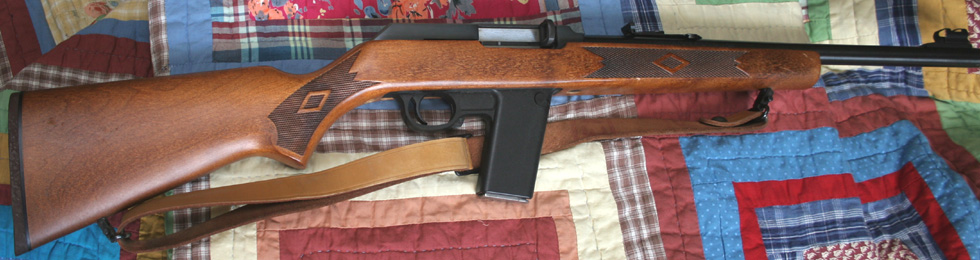
Deficiencies aside, this is a great all around gun, and the heavy .45 is no slouch out of a long or short barrel, at close range. If some one had possessed the wit to produce this gun in the forties, the M-1 Carbine, which was designed to replace the .45 auto in issue to non-combatants, would not have been necessary. The .45 carbine that did exist at the time was the famous Thompson. A comparison of the two guns is interesting. The Thompson also fired from an unlocked bolt. The earlier versions used a closed bolt, and firing pin, the later, M-1 versions fired from an open bolt with the firing pin milled right on to the bolt face. The Thompson weighed 11 ½ pounds, and was 42" long. This makes it almost twice the weight, and 7" longer than the Camp Gun. As much as I am a fan of the .45, the Thompson is just too big and heavy for this round. At the same weight you can get a Garand, firing the capable 30-06, or one of the excellent .308 assault rifles. Even the .223 cartridge, which can be had in the six pound M-16, and is very light for a rifle round, greatly exceeds the power of the potent (for a pistol) .45 A.C.P.
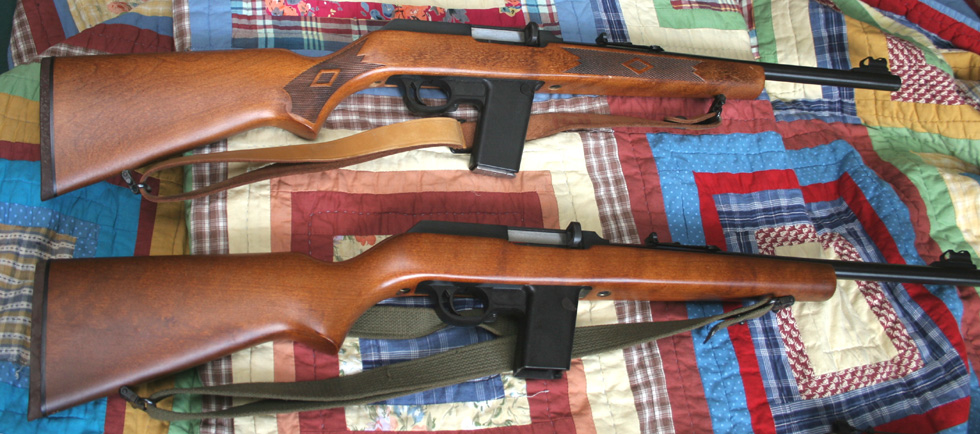
As with all carbines, the gun is very cheap for the hand loader to shoot. Group size at hand gun ranges is under two inches, at the 100 yard rifle range, a five or six inch group is about the best that this gun can do. In both cases this compares poorly to a regular rifle, but is as good or better than any thing the pistol can shoot. Overall, I like this gun a lot; within it's design range of 50 yards or so, you can comfortably hit anything you aim at. The gun is quick to fire and quick to reload, and there is little perceived recoil. The photo below shows the two Camp Guns, with the 45 at the top, and the 9mm at the bottom. many more details can be found on my page for the 9mm camp gun.