 Mini Revolver
| Dimensions | Barrel Length | Weight | Caliber | Action Type | Magazine Capacity |
| 4x2.375 Inches | 1.125 inches | 4.5 Oz. | .22 L.R. | S.A. revolver |
5 |
 actually buy one until now. On paper this would seem to be the ultimate Saturday
Night Special. It is very small, fires a pip-squeak cartridge, and is quite
cheap. I paid about $150 for mine. The specs don't tell the whole story, however,
and there is more to this interesting little gun than the numbers would indicate.
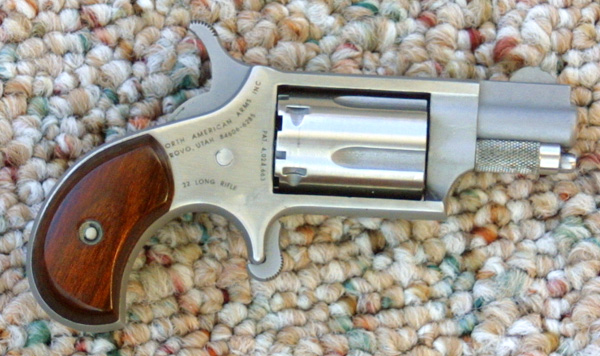
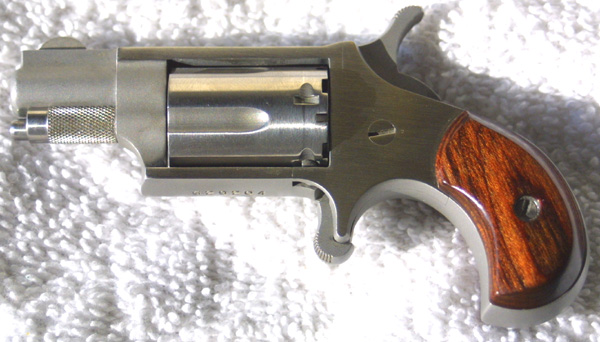
In it's favor, this is a beautifully crafted little piece. It is machined
from stainless steel, and the fit and finish are superb. Unless you are viewing
this on a very small monitor, both the photo above, and that to the right
are almost certainly larger than actual size. The first time I saw one of
these little beasts, I had to ask "is it real; does it shoot?" To the uninitiated,
these little jewels look like finely detailed toys, or little miniature models
of guns. While I filled out the paperwork at the gun shop, a woman next to
me peered over and laughed. "What's that:" she asked "does it shoot?" I had
to smile, as these were very similar to my own words upon first exposure
to the little guns years ago.
actually buy one until now. On paper this would seem to be the ultimate Saturday
Night Special. It is very small, fires a pip-squeak cartridge, and is quite
cheap. I paid about $150 for mine. The specs don't tell the whole story, however,
and there is more to this interesting little gun than the numbers would indicate.
In it's favor, this is a beautifully crafted little piece. It is machined
from stainless steel, and the fit and finish are superb. Unless you are viewing
this on a very small monitor, both the photo above, and that to the right
are almost certainly larger than actual size. The first time I saw one of
these little beasts, I had to ask "is it real; does it shoot?" To the uninitiated,
these little jewels look like finely detailed toys, or little miniature models
of guns. While I filled out the paperwork at the gun shop, a woman next to
me peered over and laughed. "What's that:" she asked "does it shoot?" I had
to smile, as these were very similar to my own words upon first exposure
to the little guns years ago. Mini revolvers come in .22 l.r., .22 magnum, or .22 short, with barrels from just over an inch, to four inches. They have also, recently begun production of 17 caliber versions. My personal gun is in .22 l.r. with the shortest barrel (1 1/8"). These are single action pistols, but their method of operation harkens back to before the time of the metallic cartridge. The action is smooth, with two distinctive clicks as the piece is cocked. There is a half cock notch, but no loading gate. The pistols are loaded by removing the cylinder, as in the old black powder revolvers. The cylinder is removed by pushing a button on the cylinder pin, and then pulling the pin forward. The cylinder pin, or some other small object, is used to push the spent cases from the chambers so that fresh cartridges may be loaded. The cylinder is then put back into place and the cylinder pin pushed back in. There are safety
 notches between the chambers so that all five chambers may be loaded. There
is no trigger guard, but
notches between the chambers so that all five chambers may be loaded. There
is no trigger guard, but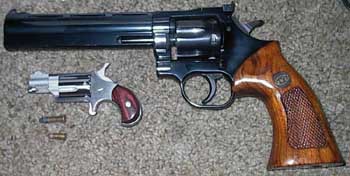 the little guns are safe as long as the hammer is not cocked, and the safety
notch is positioned under it. The trigger pull is crisp, and fairly light,
but the recoil of the little pistol can be a bit startling. Even with the
.22, a gun this small is no pleasure to shoot. Like any other .22 L.R. revolver,
this gun will also fire shorts and longs, which may take a bit of the bite
out of the recoil. The company essentially recommends this gun for ranges
of from 6 to 15 feet.
the little guns are safe as long as the hammer is not cocked, and the safety
notch is positioned under it. The trigger pull is crisp, and fairly light,
but the recoil of the little pistol can be a bit startling. Even with the
.22, a gun this small is no pleasure to shoot. Like any other .22 L.R. revolver,
this gun will also fire shorts and longs, which may take a bit of the bite
out of the recoil. The company essentially recommends this gun for ranges
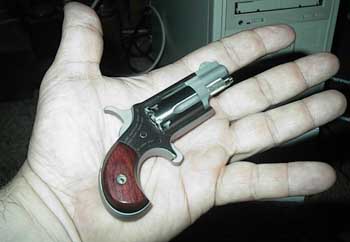
of from 6 to 15 feet. There are a fair number of options and accessories made for the Mini Revolver. There is the pivoting holster/handle, the belt buckle holster, custom grips (including a set of zirconium studded ones for a bit over $600), and a number of deep concealment holsters. When I first wanted one of these little guns, years ago, it seemed like a good idea to drill a hole in the grips, and attach the piece to my key chain. Age, experience, and further reflection have convinced me that this might not be such a good (or legal) idea. A comparison between gun and hand should give a pretty good idea of the size of this pistol, if the dimensions don't give a clear enough picture. An even more startling contrast can be drawn between my Mini Revolver, and my full sized Dan Wesson, both of which are .22 revolvers. A .22 L.R., and a .22 short are shown just under the smaller gun.
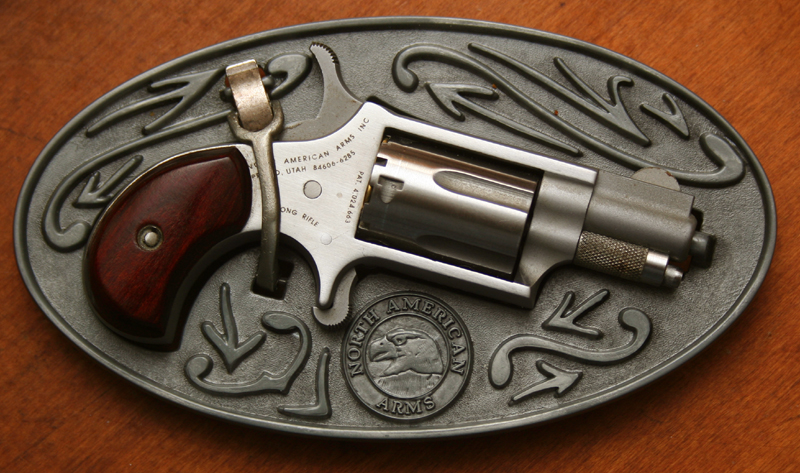 One of the more interesting accessories for these little guns, is the
belt buckle holster. This is a rather large, oval buckle that will
attach to any regular belt. It seems to be made of pewter, and is quite
heavy. The pistol fits into a cut out, within the buckle, and is secured
by a nib in the barrel, and a metal clip, just above the grip. the
legality of this method of carry is in question, but the buckle is
certainly unique. It is arguable whether this method of "hiding in plain
sight" constitutes concealment. In places where concealed weapons are
illegal. On the other hand, in places where people are permitted to
carry concealed, it is generally illegal to carry a gun in plain sight.
It is really a judgment call as to whether this method of carry is
concealed or open. Fortunately, in my home state of Wisconsin, open
carry is legal, and shall issue concealed carry has just become a
reality.
One of the more interesting accessories for these little guns, is the
belt buckle holster. This is a rather large, oval buckle that will
attach to any regular belt. It seems to be made of pewter, and is quite
heavy. The pistol fits into a cut out, within the buckle, and is secured
by a nib in the barrel, and a metal clip, just above the grip. the
legality of this method of carry is in question, but the buckle is
certainly unique. It is arguable whether this method of "hiding in plain
sight" constitutes concealment. In places where concealed weapons are
illegal. On the other hand, in places where people are permitted to
carry concealed, it is generally illegal to carry a gun in plain sight.
It is really a judgment call as to whether this method of carry is
concealed or open. Fortunately, in my home state of Wisconsin, open
carry is legal, and shall issue concealed carry has just become a
reality.
The buckle is of fairly high quality,
and has some patterns meant to look like engravings, as well as the North American Arms logo molded into
it. Off of a belt, it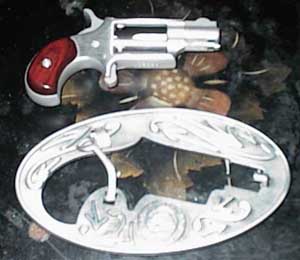 almost has the look of a small plaque. The weapon is held
securely by a small clip near the grip - perhaps too securely. It takes
a few seconds of fiddling with the clip to release the little revolver,
making this a poor choice as a method of self defense carry. The Mini
Revolver has been around a while, and I don't think much of anyone will
be taken in by the "disguise" of the belt holster; but you never know.
almost has the look of a small plaque. The weapon is held
securely by a small clip near the grip - perhaps too securely. It takes
a few seconds of fiddling with the clip to release the little revolver,
making this a poor choice as a method of self defense carry. The Mini
Revolver has been around a while, and I don't think much of anyone will
be taken in by the "disguise" of the belt holster; but you never know.
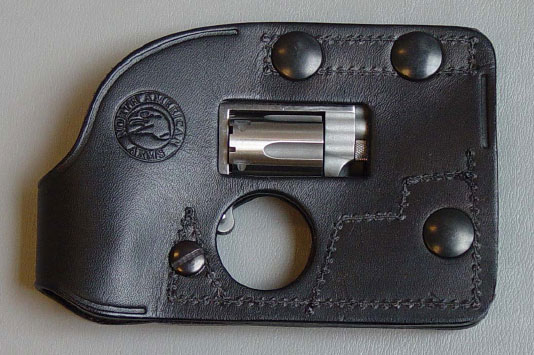 There are also
ankle holsters, shoulder holsters (?), and regular belt holsters designed
for his gun. I have even seen a holster which holds the gun at the end of a neck
chain. One of the neatest was a wallet holster, as shown in the photo to
the left (taken from the ATF website), which is no longer
made.
There are also
ankle holsters, shoulder holsters (?), and regular belt holsters designed
for his gun. I have even seen a holster which holds the gun at the end of a neck
chain. One of the neatest was a wallet holster, as shown in the photo to
the left (taken from the ATF website), which is no longer
made.
Production of the wallet holster ceased, because the ATF decided that it turned the Mini Revolver into a restricted weapon, like a pen gun. Because the gun could be fired from within the holster, and because the holster encased the entire gun, the ATF determined that this made it a disguised gun, rather than a gun/holster combination. Wallet holsters are presently being made that require removal of the gun before firing. This makes them legal. It is also legal to have a holster which remains attached to the gun, but does not completely hide or break up the profile of the gun. These laws are defended on the idea that it might be possible for a criminal to remove what looks like a wallet, during a traffic stop, point it at a police officer and fire, without the officer ever realizing that the criminal was drawing and aiming a firearm. While nobody wants to make thing more difficult or dangerous for police officers, such laws only affect law abiding citizens. Criminals do as they please, whatever the law says.
The only way to legally own such a
holster would be to own the holster only and never install it on a gun.
Installation requires removal of the grips, with the
holster than being installed using the original grip screw mounting
holes. Legally, this would then be considered an AOW, like a sawed off
shotgun, cane gun, or briefcase gun. While the transfer of such a
firearms requires only a $5 fee to the ATF, initial production of such a
weapon requires a $200 tax. So before I could "create" my new weapon by
installing the holster onto my firearm, I would need to pay the $200 fee
and then go through the usual wait and background check for an AOW.
Though the procedure is expensive and time consuming, never
underestimate the dedication of a man obsessed with a hobby.
Still, with its stainless
construction and small size - who needs a holster? You can tuck this
thing in a pocket, a shoe, or perhaps tuck it under a belt. I can
imagine wrist holsters, hat holsters, and all kinds of other
innovations. I still think about the key chain holster.
As small as this little gun might be, an even smaller
version is made. The 22 short model is about a half inch shorter, and
really does look like a toy. It is also a bit better proportioned, as
the 22 L.R. version has a bit of a stretched look. Still, the 22 L.R. is
a far better, less expensive, and more widely available round, than is
the 22 short. It is also, much more lethal. This is essentially a
novelty gun, or a fun piece; but it does have some self defense
applications.
| Loading,
firing, and cleaning. |
|
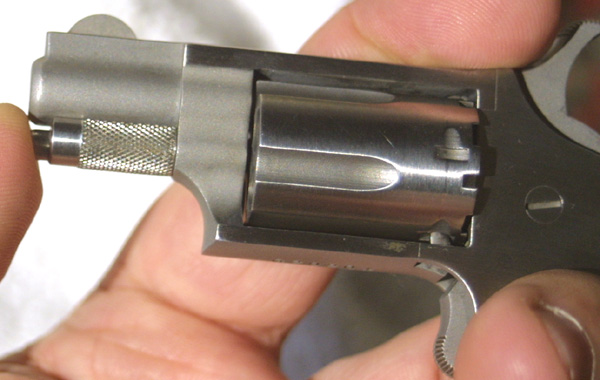
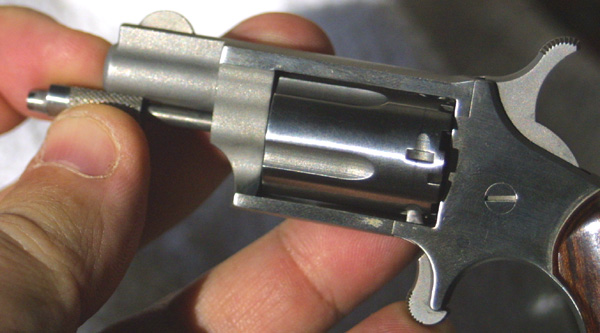
| The mini revolver is an old fashioned, single
action design. There is no swing out cylinder, and no loading gate. The cylinder
must be removed for reloading. The cylinder pin must first be removed. This
is done by pressing on a detent, at the tip of the pin. |
|
| The cylinder pin may then be pulled straight
out. This will allow the cylinder to be removed by pushing it to the right.
With this done, five 22 L.R. cartridges may be inserted. To remove spent
cases, simply punch them out with the tip of the cylinder pin. |
|
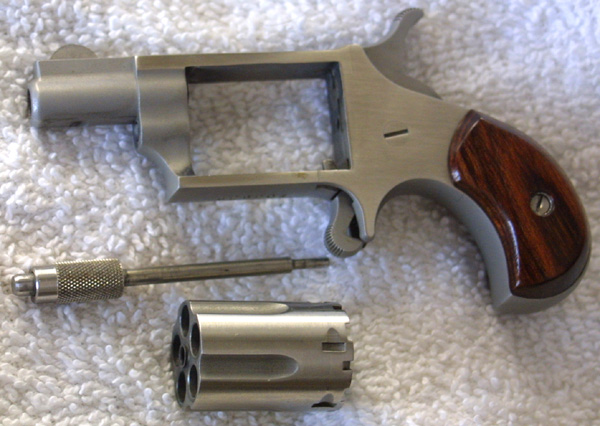
| The mini revolver, disassembled for cleaning
or loading. |
|