Radio Shack HTX-400
| Factory Specs | Modifications | Extending Capabilities | Links |
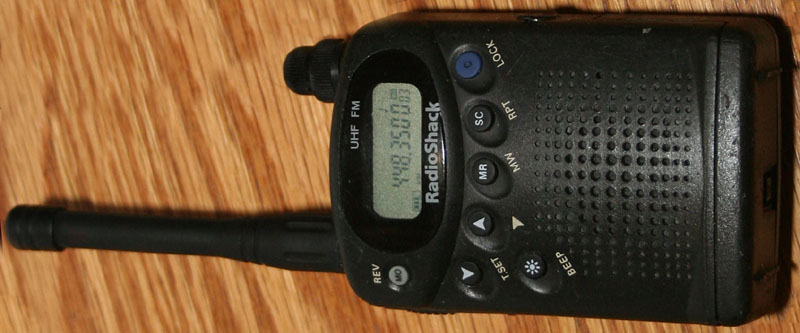
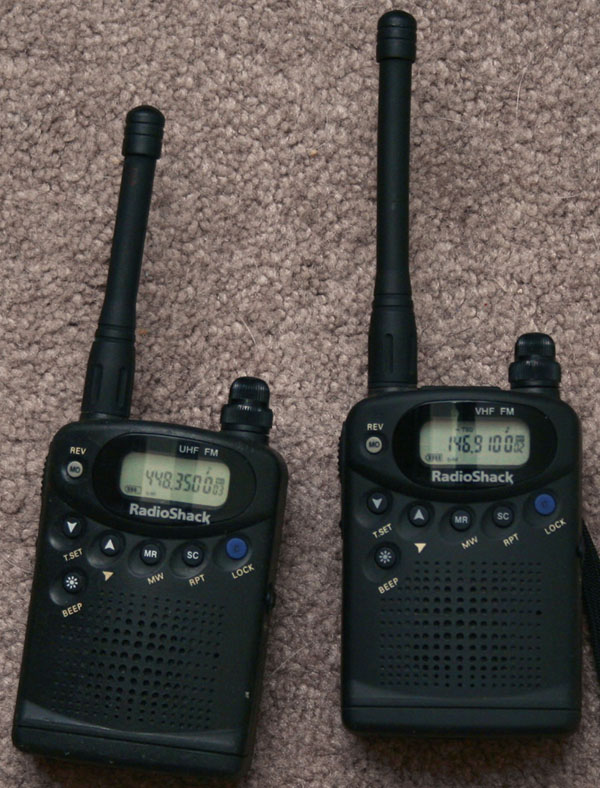
The Radio Shack HTX-400 is essentially the 70 cm twin to the 2 meter HTX-200. Rather than rehash everything I said about the HTX-200, I recommend you visit my page on the little 2 meter Radio Shack HT first. The two little radios are identical in appearance, and functionally similar. Like its twin, this radio puts out 200 mw on a pair of standard batteries, or a bit less using the 1.2 volt nicads. When using a 9 volt adapter (putting out at least 900 mAh), the unit puts out one watt. The photo below illustrates how similar the two units are in appearance. Except for the shorter antenna of the 400, the units are hard to tell apart.
 The 70 cm band is very
near that of the FRS and GMRS radios, and thus the characteristics of the bands
are similar. Most FRS radios are allowed to transmit at 500 mw, and thus put out more power than the 200mw of the HTX-400,
so range is not great. A pair of these radios might be able to reach each other
at a half mile or so; but even this is not certain. Hitting a repeater is
possible at much greater distances, due to the much better antennas that most
repeater sites have; but even here you are probably not talking more than 10 -
20 miles.
The 70 cm band is very
near that of the FRS and GMRS radios, and thus the characteristics of the bands
are similar. Most FRS radios are allowed to transmit at 500 mw, and thus put out more power than the 200mw of the HTX-400,
so range is not great. A pair of these radios might be able to reach each other
at a half mile or so; but even this is not certain. Hitting a repeater is
possible at much greater distances, due to the much better antennas that most
repeater sites have; but even here you are probably not talking more than 10 -
20 miles.
Though UHF and VHF are both limited to line of site propagation, there are some differences. Line of sight is not truly line of sight, and radio energy tends to be able to look a bit farther than actual line of sight. UHF tends to be a bit less penetrating and has somewhat less range and ability to overcome terrain obstacles. As a general rule, lower frequencies can look just a bit farther over the horizon than higher frequencies.
Because of the characteristics of the band, and the big head start that 2 meter had, 70 cm lags far behind in popularity, though it has gained a bit of a following. Still, the future of the band seems assured, if a bit less glamorous than that of 2 meter. The band is less popular than two meter, and has quite a bit more room. There are also some great radios out there, and recent developments make it easy to include the band on multi band radios.
The size of the radio, so striking in the two meter HTX-200, is a bit less impressive in the 70 cm HTX-400. Little UHF radios are quite common, far more so than little VHF radios, particularly with the huge numbers of FRS/GMRS units being sold. Still, this is a handy little radio to put in your shirt pocket.
Unlike the little GMRS/FRS radios, this unit can access thousands of frequencies, and is capable of a variety of repeater offsets, tones, and scanning modes. For its size and price it is a remarkable little thing. it can also take a full range of accessories, including an external antenna, power supply, and even an external speaker and microphone. A nearly identical model, set up for FRS, was made by Maycom for the now defunct Cherokee company.
Radio Shack had
originally been asking around $200 for these units; but eventually ended up
clearing them out for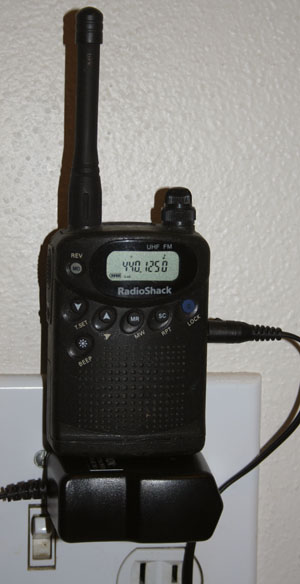 about $50 each, as it eliminated its amateur radio gear
from its product line. I was able to get the HTX-200 new, but missed out on a new
HTX-400. I have been looking for one of these
radios for years, ever since. I was eventually
able to find one on the web for about $35. This is the low end of the price
spectrum, but there is
usually no problem finding one of these radios in the $50 range. Now they sit in
my shack like a pair of twins - apparently identical, but with important
differences.
about $50 each, as it eliminated its amateur radio gear
from its product line. I was able to get the HTX-200 new, but missed out on a new
HTX-400. I have been looking for one of these
radios for years, ever since. I was eventually
able to find one on the web for about $35. This is the low end of the price
spectrum, but there is
usually no problem finding one of these radios in the $50 range. Now they sit in
my shack like a pair of twins - apparently identical, but with important
differences.
Frequency is selected in user configurable steps
of 5, 10, 12.5, 15, 20, 25, 50 kHz, or 1 MHz, by use of simple up and down
arrow buttons on the face of the unit. These may be cycled through manually,
or scanned. Thirty memory locations are available for favorite frequencies.
For repeater use, offset may be set from 0-8 mhz in 100khz steps. The unit
is also capable of generating, and responding to a series of 47 subaudable
continuous tones for repeater, call, or paging use.
Standard convenience, and operation features include
earphone and external microphone jacks, external power jack, back lit display,
and key lock. During normal operation, the display itself shows the frequency,
signal strength, status of the tone squelch, and offset, along with indicating
transmit or receive function. It also displays a number of menus when the
unit is being set up, and indicates the battery when the unit is first
turned on.
Like most of the modern little radios
out these days, you really need the manual to do anything. Computer control
means that many functions and memories can be contained in quite a small unit.
All keys serve multiple functions, and each model of radio seems to speak its
own language, which must be learned by the operator. Still, without such a
system, it would be impossible to fit so many features into such a small radio.
I found a little nine volt power adapter for this unit, and discovered the radio
is so small that it can sit on top of the power adapter like a book on a shelf.
I suppose this makes it the smallest base in the house (tied with the equally
diminutive HTX-200), complete with scanning, memories, and full offset and tone.
So what good is a one watt base with a tiny antenna?
The only way to get any real use from these radios is by accessing repeaters. Standard offset (upon which the repeater receives, and the user transmits) for 70cm is generally 5 MHz above or below the transmit frequency. Repeaters for 70 cm are not nearly as common as those for 2 meter, but there numbers are slowly growing. Most urban areas have several. Even so, it is considerably harder to fill all of the 30 included memories of this unit, than the identical number of memories in its 2 meter sibling. I have listed the local repeaters in my home area below.
Without a nearby repeater, 70cm does give the virtue of privacy. Between the limited range, and the huge number of frequencies available within the 30 MHz bandwidth, there are always plenty of open frequencies available. This is the land of wide open spaces.
| Repeater | Transmit (user receive) | Receive (user transmit) | Tone | Offset | Location |
| Pewaukee | 443.125+ |
448.125+ |
127.3 | 5 Mhz + | |
| Oconomowoc | 442.025 | 447.025 + | 127.3 | 5 Mhz + | |
| Delafield | 444.125 | 449.125 + | 127.3 | 5 Mhz + | |
| Menomonee Falls | 444.425 | 449.425 + | 127.3 | 5 Mhz + | |
| Milwaukee | 442.650 | 447.650 + | 127.3 | 5 Mhz + |
| Frequency | Receive | 420 - 470 MHz |
| Transmit | 420 - 450 MHz | |
| Frequency Stability | +/- 5ppm | |
| Operating Temperature | 14 to 131 degrees F (-10 to 55 degrees C) | |
| Power Source | DC 3.0V to 9V (at least 900 ma) | |
| Modulation | F3E | |
| Impedance | 50 Ohm | |
| Dimensions | 2-1/4 x 3-3/8 x 1-1/16 inches (85 x 58 x 26.5 mm) | |
| Weight (without batteries) | 4.2 oz (120 g) | |
|
|
||
| Circuit Type | Dual Conversion, Superheterodyne | |
| IF Frequency | (1st IF) | 30.85 MHz |
| (2nd IF) | 450 kHz | |
| Sensitivity | 0.22 uV for 12 dB SND | |
| Selectivity | 50 dB Min. | |
| Spurious and Image Rejection: | 60 dB Min | |
| Intermodulation | 60 dB Min | |
| Distortion | 10% Max. | |
| S/N Ratio | 40 dB Min. | |
| Audio Output @ 10% THD | 50 mW 16 Ohm, BTL | |
|
|
||
| Power Output | 200 mW, DC 3.0V/1W, DC 9.0V | |
| Distortion | 5% | |
| Deviation | +/- 5 kHz | |
| S/N Ratio: | 36 dB | |
| Current Drain | 600 mA | |
| Radio Shack | Manual for this radio | eham reviews | QST review. |